



The research on biofeedback for the R sound is hard to argue with. Study after study – from Preston, Byun, Hitchcock, McAllister, and others – shows that when kids can see their own speech in real time, they make faster progress on residual errors than with traditional therapy alone.
A large-scale preregistered randomized controlled trial published in 2025 found that children using visual-acoustic biofeedback made progress 2.4 times faster than children receiving traditional therapy. That’s not a small effect. That’s the kind of result that can (and should) change how we practice.
So why aren’t more SLPs using biofeedback?
Cost and time. That’s almost always the answer.
Ultrasound biofeedback is incredible. I actually own an ultrasound unit and use it in my practice – the real-time visual of tongue movement is genuinely powerful, especially for kids who’ve been stuck for years. But ultrasounds cost thousands of dollars. Some SLPs pursue grants to fund them, and it’s worth exploring if you work in a research-friendly setting. For most SLPs? It’s just not realistic (yet).
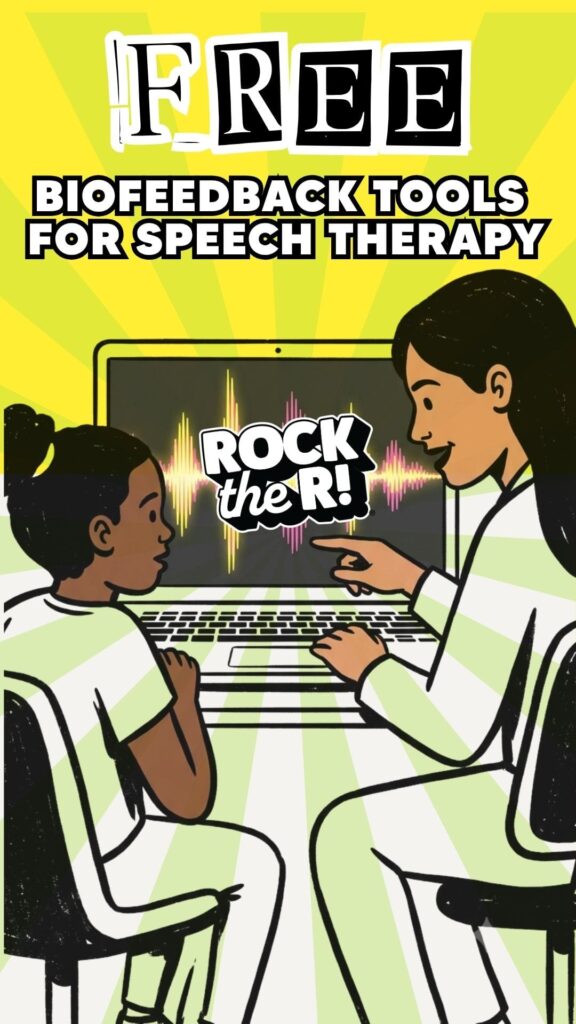
Here’s the thing though: ultrasound isn’t the only option. Visual-acoustic biofeedback works differently – instead of showing tongue position, it shows the acoustic properties of the child’s speech as a real-time wave. The child adjusts what they’re doing with their mouth and can see immediately whether those adjustments are moving their sound closer to the target. It’s validated by rigorous clinical research, it runs on a laptop or tablet, and – importantly – some versions are completely free.
Disclosure: I started recommending staRt publicly in 2022 – years before I ever met Dr. Tara McAllister, the researcher behind it. I found it on my own, started using it with my students, and wrote about it because it genuinely changed how I was treating the R sound. I now have a professional relationship with Dr. McAllister, but my opinion of this tool has never changed. It’s still my top recommendation.
Head to bitslabstart.com to access it directly in your browser. Here’s what it does: the child speaks into a microphone and sees their speech rendered as a wave in real time. The goal is to get the third formant peak to align with a target line – a visual cue that corresponds to accurate R production. When the peaks match up, the sound is right. When they don’t, the child can see exactly what direction to adjust. If you’ve never used it before, start here. This tutorial walks you through the basics:
A large-scale preregistered randomized controlled trial published in 2025 found that children using visual-acoustic biofeedback made progress 2.4 times faster than children receiving traditional therapy. That’s not a small effect. That’s the kind of result that can (and should) change how we practice.
So why aren’t more SLPs using biofeedback?
Cost and time. That’s almost always the answer.
Ultrasound biofeedback is incredible. I actually own an ultrasound unit and use it in my practice – the real-time visual of tongue movement is genuinely powerful, especially for kids who’ve been stuck for years. But ultrasounds cost thousands of dollars. Some SLPs pursue grants to fund them, and it’s worth exploring if you work in a research-friendly setting. For most SLPs? It’s just not realistic (yet).
Here’s the thing though: ultrasound isn’t the only option. Visual-acoustic biofeedback works differently – instead of showing tongue position, it shows the acoustic properties of the child’s speech as a real-time wave. The child adjusts what they’re doing with their mouth and can see immediately whether those adjustments are moving their sound closer to the target. It’s validated by rigorous clinical research, it runs on a laptop or tablet, and – importantly – some versions are completely free.

The staRt App: Free, Research-Backed, and Incredibly Useful
The best free option out there, in my opinion, is staRt, a visual-acoustic biofeedback tool developed at NYU by Dr. Tara McAllister and her team of researchers. I have been using this app since 2022 and it has completely changed the way I treat the R sound.Disclosure: I started recommending staRt publicly in 2022 – years before I ever met Dr. Tara McAllister, the researcher behind it. I found it on my own, started using it with my students, and wrote about it because it genuinely changed how I was treating the R sound. I now have a professional relationship with Dr. McAllister, but my opinion of this tool has never changed. It’s still my top recommendation.
Head to bitslabstart.com to access it directly in your browser. Here’s what it does: the child speaks into a microphone and sees their speech rendered as a wave in real time. The goal is to get the third formant peak to align with a target line – a visual cue that corresponds to accurate R production. When the peaks match up, the sound is right. When they don’t, the child can see exactly what direction to adjust. If you’ve never used it before, start here. This tutorial walks you through the basics: